Usually, yes, but not always by the route people expect, and not always with the battery they had in mind.
The answer comes down to one component: the inverter. If yours is a hybrid model inverter with a battery port, a compatible battery may connect directly. If it’s a standard string inverter, which most Irish systems installed before about 2021 have, you are choosing between an AC-coupled battery that works alongside it, or replacing it with a hybrid.
Tell us what inverter you have and the checker below will tell you which of those three routes applies, in about ninety seconds.
batteryinstall.ie / compatibility
Can your solar take a battery?
Nearly always yes — the real question is which route. Four questions and we'll tell you whether you're an AC-coupled retrofit, a hybrid changeover, or already halfway there.
Step 1 What's on the wall
Step 2 Inverter brand
It's the box near your consumer unit, usually in the attic, garage or utility. Brand is on the front.
Step 3 Type and age
A hybrid is battery-ready out of the box. If the model name ends in something like "-H", "Hybrid", "ES", "SPH" or "Gen24", it probably is.
Step 4 What you want from it
This changes the design, so it's worth deciding now rather than later.
Nobody knows their model number. Everybody can photograph a sticker — it's the single most useful thing you can send us.
Recommended route Pending
—
Answer the questions on the left and the recommendation appears here.
ESB Networks
—
Whether the change needs notifying.
Existing warranty
—
Effect on cover you already have.
What happens next
We'll list the exact steps once we know what you've got.
The Three Retrofit Options, and how to tell which is your option
Almost every battery retrofit in Ireland falls into one of three categories. The differences matter, because they carry very different costs and very different amounts of disruption
Option 1
Your inverter is already hybrid
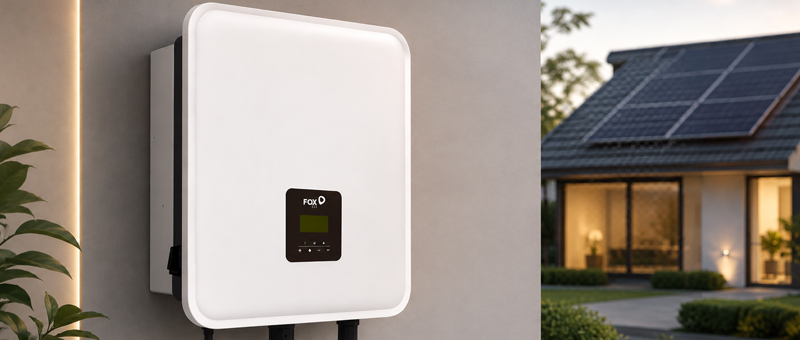
A hybrid inverter has a DC battery input built in. It manages solar and battery together, from one unit, on one app. If you have one, adding a battery is the cleanest and cheapest retrofit available: no inverter change, no second box on the wall, no re-notification of a new generator to ESB Networks.
The catch is that hybrid doesn’t mean universal. A hybrid inverter will normally only accept batteries from an approved list, at approved firmware versions, within a maximum supported capacity. A GoodWe hybrid will not take a Sigenergy battery. Some models cap total storage lower than customers expect. We confirm the exact model number and current firmware before quoting anything.
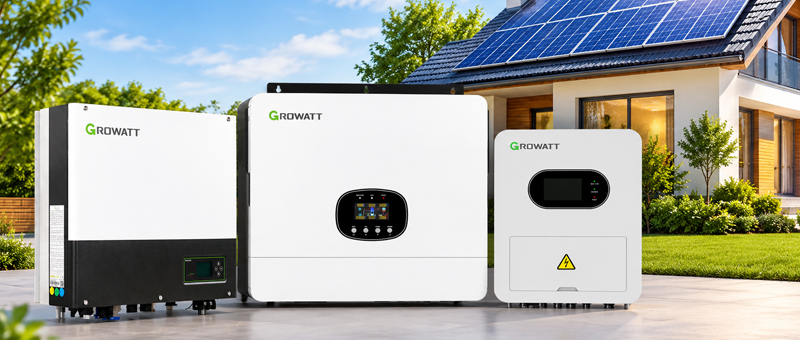
Common hybrid models on Irish roofs: GoodWe ET and EH series, Solis RHI and S6, FoxESS H1 and H3, Sungrow SH-RS, Huawei SUN2000 L1 with LUNA2000, SolarEdge Energy Hub, Growatt SPH.
Option 2
String inverter, replaced with a hybrid
A standard string inverter converts DC from the panels into AC for the house. It has no battery input and no way to control charging. If yours is one of these and you want a DC-coupled battery, the inverter is replaced.
That’s more work than it sounds. The new inverter has to suit the existing array — string voltage, string current, MPPT count and configuration all have to check out, because the panels were sized around the old inverter, not the new one. The existing isolators, cabling and protection may need modification. The change is notifiable to ESB Networks, and the installation is certified afresh under IS 10101.
It’s the right call more often than you’d think, though — particularly where the original inverter is over eight years old, out of warranty, or already showing faults. You’re replacing a component that was going to need replacing anyway, and getting battery capability for the incremental cost.
Common string inverters we see: SMA Sunny Boy, Fronius Primo, Solis 4G/5G single-MPPT, SolarEdge SE-series with power optimisers, Growatt MIN TL-X, older Huawei SUN2000 KTL.
Option 3
AC-coupled battery alongside the existing inverter
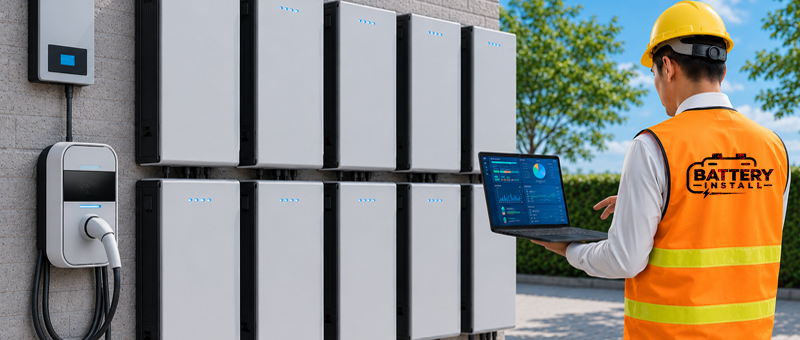
An AC-coupled battery has its own inverter built in. It sits alongside your solar system rather than inside it, measures what’s flowing in and out of the house through CT clamps or a meter, and charges or discharges accordingly. The original solar inverter is untouched.
This is the route for anyone whose solar inverter is working well and out of scope for replacement — and it’s essentially the only route for microinverter systems. If you have Enphase or APsystems, there is no string inverter to replace, so an AC-coupled battery is the answer.
The trade-off is efficiency. In an AC-coupled system, surplus solar goes DC → AC (solar inverter) → DC (battery) → AC again (battery inverter) on its way to your kettle. Each conversion costs a little. Round-trip efficiency on a good AC-coupled system lands around 85–90%, against roughly 90–95% for DC-coupled. On 2,000 kWh of stored energy a year, that difference is worth perhaps [ 100–150 kWh ] — real, but rarely the deciding factor.
What actually determines compatibility
The inverter model is the starting point, not the whole answer. Before we quote, we confirm:
What we check
Why it matters
Exact inverter model and revision
Two inverters with the same family name can differ generationally
Firmware version
Battery support is frequently added — or restricted — by firmware
Approved battery list for that model
Manufacturer approval, not "it fits physically"
Maximum supported storage capacity
Some hybrids cap total kWh well below what customers want
Array string voltage and current
Determines whether a replacement hybrid can drive the existing panels
Consumer unit spare ways and main fuse rating
Battery circuits need protection and, sometimes, a board change
CT clamp and meter position
Wrong placement is the single most common cause of a battery "not working"
Proposed battery location
Clearances, ventilation, ambient temperature, fire separation
Broadband coverage at the inverter
No connection means no monitoring, no firmware updates, no remote support
Single-phase or three-phase supply
Three-phase narrows the compatible product list considerably
We also check something that isn’t technical at all: whether a battery makes sense for how you actually use electricity. A house that exports very little surplus and goes to bed at nine will not fill a 15 kWh battery. We’d rather tell you that before you spend the money.
What systems we can work with
We assess and install across most of the systems on Irish roofs. That splits into two lists, and the distinction is worth understanding.
Systems we supply and install
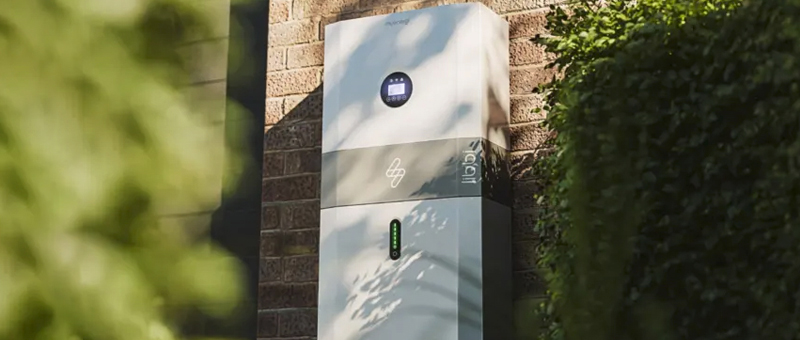
Sigenergy, FoxESS, Myenergi Libbi, Tesla Powerwall, Goodwe, Dyness
Systems we can assess, work alongside or expand
Solis, Growatt, GoodWe, SAJ, SMA, Fronius, FoxESS, Sungrow, Huawei, GivEnergy, Enphase, APsystems, SolarEdge, Victron, and others.
If your inverter isn’t on either list, send us the label photograph anyway. The Irish market has a long tail of rebadged and discontinued equipment, and we’ve usually seen it before.
The GivEnergy Question
GivEnergy entered administration in April 2026, which left a large number of Irish owners with equipment, no manufacturer support, and no obvious route to expansion. If that’s you: the systems generally keep working, but firmware support, warranty claims and replacement modules are the problem, not day-to-day operation.
We can assess GivEnergy installations and set out the realistic options, which usually means either running the existing system to end of life, or an AC-coupled addition that doesn’t depend on GivEnergy support. What we won’t do is sell you additional GivEnergy modules.
Grants, VAT and notification —
the bits people get wrong
There is no SEAI grant for battery storage.
There never has been. The SEAI Solar PV grant covers panels only, and it does not extend to a battery added later. Anyone telling you otherwise is either confused or selling something. Say this to us before you sign anything with anyone else.
VAT is charged at 23% on a battery retrofit.
This catches people out, because the solar panels themselves were almost certainly zero-rated. The zero rate applies to the supply and installation of solar panels on a private dwelling. A battery installed later, on its own, is a separate supply and doesn't fall inside it — so it carries the standard 23% rate.
It isn't a mark-up and it isn't optional.
Every compliant installer in Ireland charges it on a battery-only retrofit, and any quotation that doesn't should prompt a question about how that installer is treating VAT generally. All our residential prices are quoted inclusive of VAT at 23% so you're comparing the real number. More on VAT and battery pricing.
ESB Networks notification.
Adding storage to an existing microgeneration installation is notifiable. Where the inverter is replaced or generation capacity changes, the NC6 position needs revisiting. We handle the paperwork; you don't need to do anything, but you should know that an installer who doesn't mention it at all is a warning sign.
Certification.
Every installation is certified under IS 10101 and completed by a Safe Electric registered contractor. [ Registration number ]. You get the certificate; keep it with your house documents, because it matters at sale and for the BER.
Frequently asked questions
Is my inverter battery-ready?
The model number tells us. Photograph the label on the side or underside of the inverter — the model and serial are usually on the same sticker — and run it through the checker above. Hybrid models normally have "hybrid", "ES", "EH", "ET", "SPH", "RHI" or "Energy Hub" somewhere in the name, but there are enough exceptions that guessing isn't worth it.
Do I have to go back to the company that installed my solar?
No. We work on systems installed by anyone, including companies that have since ceased trading. Your existing panel warranty is with the panel manufacturer and isn't affected by us adding storage. Your original installer's workmanship warranty may be, depending on its terms — we'll tell you if we see anything that would put it at risk.
Can I add a battery if I don't have a smart meter?
Yes, the battery will work. But you'll need a smart meter for Clean Export Guarantee payments and for any time-of-use tariff, and both of those are usually part of the reason for adding a battery in the first place. ESB Networks installs smart meters free of charge on request.
Will adding a battery void my solar warranty?
Panel and inverter product warranties sit with their manufacturers and are unaffected by a properly certified addition. Where we replace an inverter, its warranty ends with it and the new unit carries its own. Installer workmanship warranties vary — worth checking your original paperwork.
Can I add a battery to microinverters?
Yes, via an AC-coupled battery. Enphase and APsystems systems have no central inverter to replace, so AC coupling is the route. It works well.
How long does the installation take?
A battery onto an existing compatible hybrid is typically [ half a day to a day ]. An inverter replacement plus battery is typically [ one to two days ]. Power is off for part of it; we'll tell you roughly how long when we quote.
Does a bigger battery always save more?
No. A battery only earns when it's cycling. If your surplus solar and your evening usage can't fill and empty it most days, the extra capacity sits idle and the payback gets worse, not better. The sizing calculator shows this directly.